Champagne
Great Wines of France: Champagne
Champagne terroir: A dual climatic influence
Climate, location and landscapes. The Champagne vineyards are bathed in a dual climate subject to both continental and oceanic influences. This phenomenon is unique to Champagne and not found in any other French wine-making region. What it means in practice is that there is a kind of conflict between two distinct climatic conditions: thanks to the oceanic influence, the vineyards are blessed with fairly mild temperatures. It is neither too cold in winter nor too hot in summer. The average annual temperature is 11°C. However, continental influences can lead to freezing temperatures in winter without warning. In places, temperatures below -10°C have been recorded, bringing frosts that can be devastating for the vineyards. The reverse can also happen in summer, with rising temperatures sometimes culminating in violent storms. Champagne is accustomed to fickle weather and has already spent a century developing various tools to tackle climate change. Overall, these climatic conditions are also beneficial for the vines and producing sparkling wines though, in more ways than one. The Champagne region gets plenty of sunshine in the summer, which is perfect for the grape clusters to develop. There is a steady and moderate amount of rainfall through the year: an almost ideal water supply for the grapes. This is helped by the fact that the vines are planted on sloping hillsides so as to soak up as much sunlight as possible. The finest vintages are crafted from grapes which have achieved a subtle balance between acidity and sugar levels. Sunlight and rainfall are pivotal where these two parameters are concerned.
Soils. In Champagne, the outcrops of sedimentary rock are 75% limestone, composed of chalk, marl and limestone proper. This type of subsoil is porous, thus allowing for good drainage. It therefore provides vines with excellent growing conditions, as their roots will stay dry (and avoid rot) and, in turn, this helps to increase grape quality. Even though the region's subsoil also comprises other sediments, the Champagne vines thrive best on chalk. But what exactly is chalk and how did it form? It is made up of fragments of marine micro-organisms deposited millions of years ago. Being highly porous, it acts as a reservoir (storing 300-400 litres of water per m3). This ensures that the vines have a steady supply of water even in the driest summers.
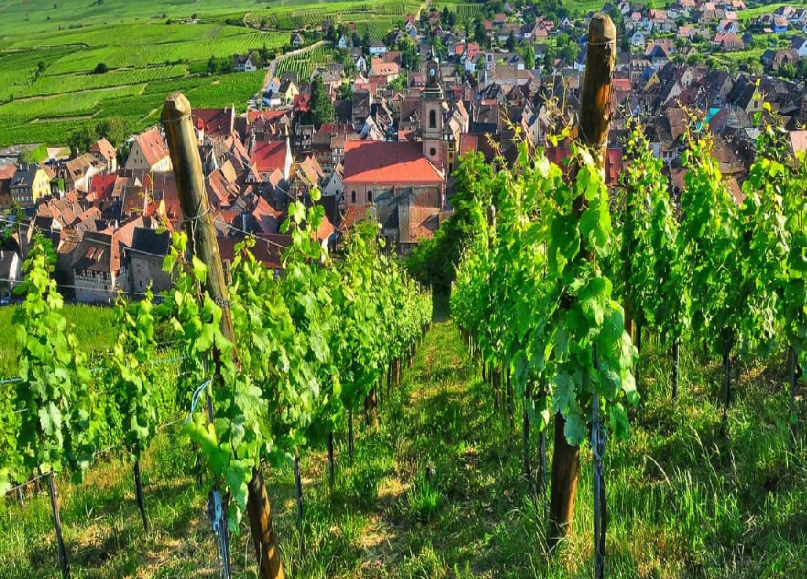
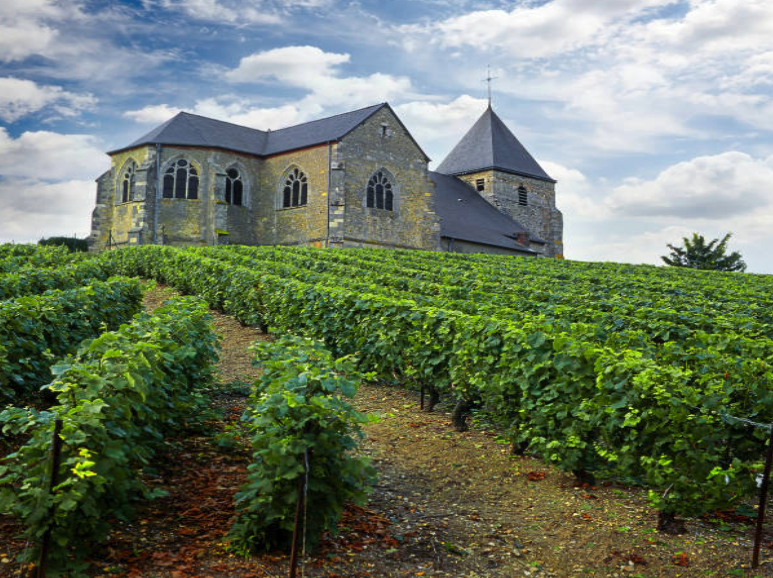
Viticulture. There are three grapes grown to produce Champagne: Pinot Noire and Meunier, both red grapes, and Chardonnay. Different districts and producers grow different amounts of each and the champagne in turn has blends of the three in different proportions. The unique terroir ensures low sugars and high tartaric acid, ideal for bottle fermentation, which in turn enables it to soak up the slowly evolving yeast complexed aromas. There are a number of vine trainings, some of which are not allowed for cru production. Grapes must be picked in whole bunches; thus, all is harvested by hand. Whole bunch pressing is required by law, traditionally using a pressoir Coquard, but now being substituted by inclined stainless-steel presses.
Champagne Production Method (Méthode Champenoise)
First fermentation: The base wine, made from rather acidic grapes (a shorter and cooler growing season than most grape growing areas), is fermented at 68 oF -71.6 oF in either stainless steel tanks or occasionally in oak barrels. It is then siphoned off from the sediment and kept at colder temperatures to clear completely, being drawn off and blended with wines from other areas and years (except in the case of vintage champagne). The wine is bottled and the liqueur de tirage (sugar, wine and yeast) is added.
Second fermentation: The bottles are stored for a year or more in cool chalky cellars. The yeast converts the sugar to alcohol and carbon dioxide, which produces the sparkle, the yeast die leaving a deposit. To remove this, the inverted bottles are turned and tapped daily (remuage) to shift the deposits into the neck of the bottle. Finally, the deposits are expelled by the process known as degorgement, and a bit of sugar syrup (liqueur d'expedition) is added to adjust the sweetness before the final cork is inserted.
Levels of Champagne Sweetness
| Style | Residual Sugar / Notes |
|---|---|
| Brut Nature | No sugar added, up to 3 g/l (absolutely bone dry). |
| Extra Brut | 0 to 6 grams per litre. |
| Brut | Less than 12 grams per litre. |
| Extra Sec / Extra Dry | 12 to 17 grams per litre (dry to medium-dry). |
| Sec / Dry | 17 to 32 grams per litre. |
| Demi Sec | 32 to 50 grams per litre. |
| Doux | (sweet) – 50+ grams per litre (very sweet; this style was favoured by the tsars but is no longer commercially produced). |
Champagne Wine Styles
There are 18; the seven based on residual sugar levels are above. Three others are briefly described below.
Rosé: it is not a recent wine: the first conventional rose was produced in 1764. Rose involves exclusively the maceration of skins and juice to extract pigments, and is blended with white wines, for a period the only wine in Europe where red and white blending was permitted.
Vintage Brut: No vintage Champagne may be sold until after at least 36 months after the date of bottling. The laws restrict each producer from making or selling more than 80% of any year's harvest as vintage Champagne. This is to ensure that at least 20% of the highest quality crops are reserved for the following years' blending of non-vintage cuvees, the foundation of the entire wine industry. It is the product of stricter selection during assemblage of crops only in vintage years.
Prestige or Deluxe Cuvée: This is typically made from a producer's own vineyards, with a blend that is often restricted to grand cru grapes, although a few also include some premier cru. They are invariably produced by the most traditional methods: fermented in wood, sealed with a cork and agrafe rather than a crown-cap; aged for longer than the regular vintage cuvee, and sold in specially shaped bottles at very high prices.
Interesting Facts about Champagne
- ✦There are almost 12,000 different brands of Champagne including over 3,000 "buyers own brands".
- ✦Of the 36,604 owners of AOC Champagne vineyards, most are absentee landlords, with only 15,800 who actually work the land.
- ✦3,200 growers make and sell their own Champagne.
- ✦Individual Champagne growers own 90% of the vineyards but sell only 18% of all produced. Cooperatives sell another 9%.
- ✦Champagne's 264 Houses own only 12% of the land but account for 73% of the Champagne sold.
- ✦There are 250 million bubbles in a Champagne bottle!
Sources: Comité interprofessionnel du vin de Champagne, champagne.com; The New Sotheby's Wine Encyclopedia, Stevenson and Szentkiralyi, National Geographic, 2020; tourisme-en-champagne.com; France, Eyewitness Travel, 2012.
Experience Champagne in person
Join one of our curated Champagne tours and explore the chalk caves, legendary Houses, and spectacular vineyards firsthand.